Showtec LAMPY
Product ownership, direction and UX/UI design for the LAMPY lighting console.
View productProduct direction, UX/UI and technical advisory.
Grounded in years of working with entertainment technology.
I’m Denis, a lighting programmer and designer working in product direction, UX/UI and technical advisory.
My work spans international touring, broadcast and live production, with different shows, teams and working environments. It spans lighting and video programming, pre-visualisation and the systems that connect them. That experience gives me a practical understanding of how people use technology when a production depends on it.
That experience shapes how I approach product development. I listen to users to understand their goals, the way their teams work and the realities of a production. The aim is to solve meaningful problems without adding unnecessary complexity.
Today, I bring that perspective to product direction, interface design and advisory work in entertainment technology.
The Wholehog 2 jump-started my career, and its UX is still a source of inspiration for my product work. I still enjoy programming it — there’s a short video of a personal virtual concert if you’re curious.
My product work brings together user feedback, feature definition, UX and UI. I help turn practical needs into a coherent experience, then keep refining it with the people who use it.
Product ownership, direction and UX/UI design for the LAMPY lighting console.
View productProduct ownership, direction and UX/UI design for the previous Chimp generation.
View productProduct ownership, direction and UX/UI design for Chimp G3, the 2026 generation.
Read the Chimp G3 case study View product rangeUX design and advisory for the Strand 500ML lighting console.
View product archiveDeveloping the next generation of Chimp with a product series in mind from the start, shaped by user feedback throughout development and beyond release.
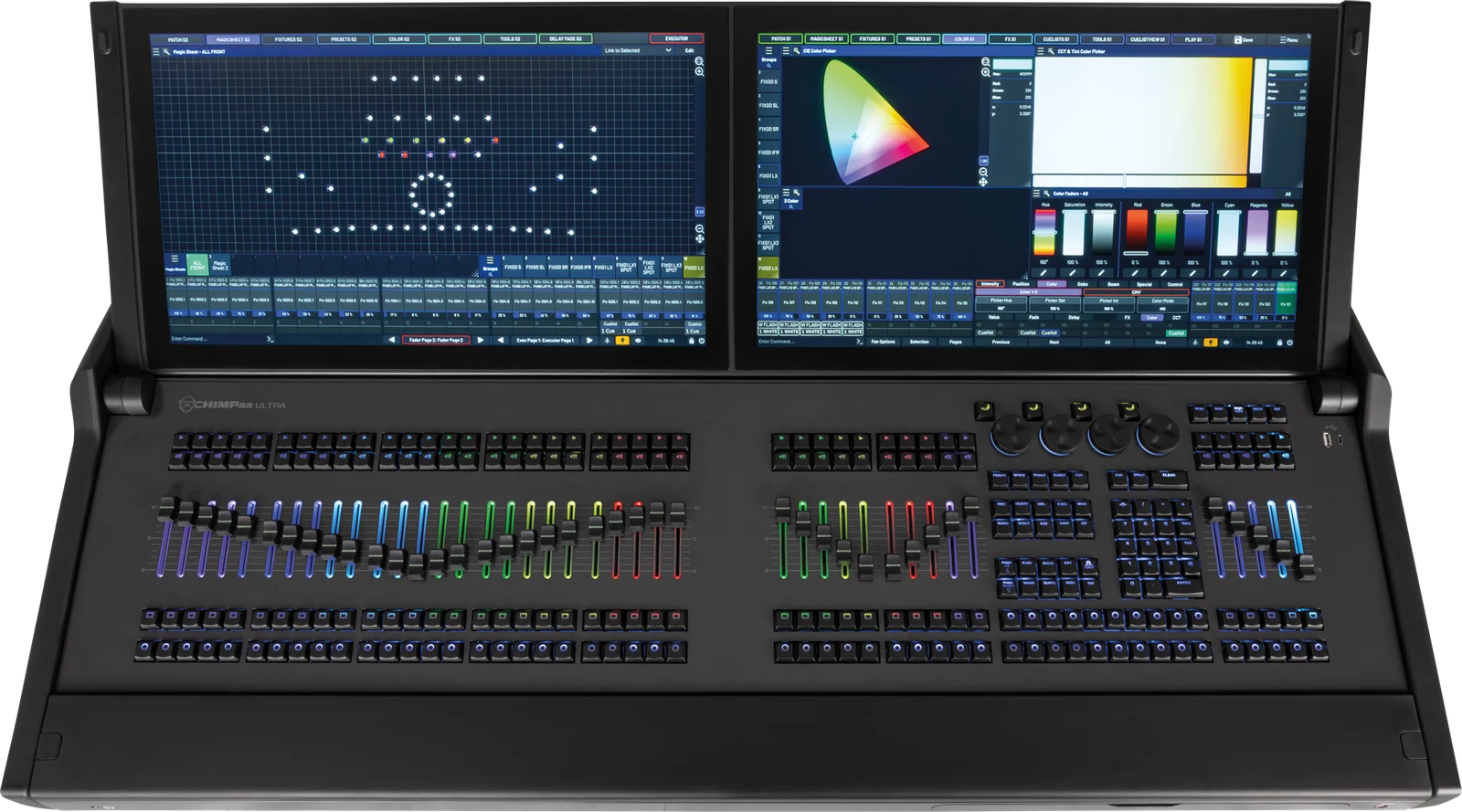
The G1/G2 platform was successful, but its hardware was ageing. The starting point was to bring customer experience, the competitive landscape and new requirements together into a direction for its successor.
My clients were Highlite and Bretgeld Engineering, the company responsible for implementation. My contribution formed part of that wider development effort. The timeline follows our work from the initial planning through early demonstrations, internal testing and launch.
Highlite approached me to help plan the next steps for the successful but ageing Chimp G1/G2 hardware platform. Together, we reviewed previous customer feedback, competing products, our own ideas and the requirements for the next generation.
Development began in 2024, taking that planning work into the next generation of Chimp hardware and software.
At Prolight + Sound in Frankfurt, we demonstrated the first software version to hundreds of people. It ran on the target PC hardware, before full console integration. The conversations, feedback and direct contact with users helped us further define the product.
Shortly afterwards, we began internal testing of development builds, with nightly updates. Alongside that testing, we gathered customer feedback through Discord and Nolt to inform ongoing refinement.
The console itself was first presented to the public at ISE 2026, following the early software demonstration the previous year.
Chimp G3 reached its official release in September 2026, with Core and Ultra as the first two consoles in the series. We continue to collect customer feedback through Nolt after release.
For me, the project shows the value of keeping product direction connected to users: from reviewing earlier feedback to early demonstrations and an ongoing conversation as the series develops.
User feedback is an ongoing conversation. My job is to understand what people are trying to achieve, where the friction is, and which changes will make their work easier.
A request for another button may point to a workflow with too many steps, a function that is hard to find, or unnecessary configuration. Understanding the underlying problem opens up better solutions.
Community votes are a valuable signal. I weigh them alongside wider impact, reliability, technical implications and product direction. A quieter issue can matter just as much as a popular feature.
Professional users build habits and muscle memory around predictable behaviour. Changes to an established workflow need a good reason. Progress means making the work easier while keeping that trust.
Useful features. A product people love.
A strong feature set matters. I aim beyond minimum viability towards a Minimal Lovable Product: meaningful functionality, dependable workflows and an experience people enjoy using. From there, keep learning and improving with the people who use it.
Writing and conversations about the technology, the people using it and the experience behind my work.
My guide to PWM, dimming resolution and the details that make a fade feel right.
Read the article ARCHIVED WEBINAR / ENGLISHCAST AcademyAn earlier webinar on optimising drawings, with examples from my Eurovision 2019 work. Software and workflows may have changed since the recording.
Watch the webinar PODCAST / GERMANAlte Hasen / #013My guest appearance: “Denis Hessberger — oder auch die Kids werden mal erwachsen.”
Listen to episode 013My production background includes the Eurovision Song Contests in Baku and Tel Aviv, the Commonwealth Games in India and Thirty Seconds to Mars’ 2013 tour. Here are a few earlier interviews and contributions.
A product idea, a workflow to improve, or a question that needs another perspective. Send me a message, or use a few guided questions to shape your brief.
What are you working on?